
AI Voices and Synthetic Audio
Media Literacy
AI Voice Scams: A Family Guide to Verify Safely
Help children handle surprising AI voices and videos: pause, verify through a known route, protect private information, and ask an adult.

Children are growing up with voice notes, videos, and calls that can be recorded, edited, computer-generated, or a mixture of all three. A familiar voice is no longer proof that a message is genuine. That can feel unsettling, but the most useful family response is calm, practical, and repeatable: pause, check, and ask for help when something feels urgent or unusual.
Why AI voices deserve a family conversation
Synthetic audio can be used for harmless creative projects, such as storytelling, language practice, or a silly family game. The same technology can also make a false request sound convincing. The risk is not that children need to become experts at identifying every fake. Even adults can miss a convincing clip. The real skill is recognising when a message deserves a second check before anyone replies, forwards it, shares information, or spends money.
This is a media-literacy habit, not a reason to frighten children. You can explain it simply: “A recording can sound real even when the message is not from the person we think. When a message creates pressure, we pause and check another way.” That one rule is more useful than a long list of technical warning signs.
Teach the pause, not panic
Start with the feeling a message creates. A child does not need to decide whether audio is “real” or “fake” on the spot. Instead, they can notice whether it tries to rush them. It may ask for help immediately, tell them to keep a secret, claim that something bad will happen if they wait, or ask them to move to a new app. Those are sensible moments to stop.
A family pause can sound like this:
• I do not have to answer right away.
• I do not have to forward this.
• I can show a trusted grown-up.
• We can check using a known contact method.
This removes the pressure to be clever. It also works for ordinary scams, misleading posts, group-chat rumours, and unexpected messages from a familiar account.
Use a second route to verify
The safest next step is to use information you already trust—not a phone number, link, or reply button inside the surprising message. If a voice note appears to come from a relative, call that person using a saved number or speak with them another way. If a video makes a big claim, look for a reliable source that is not simply repeating the same clip. If a child is unsure, the right answer is to bring it to a trusted grown-up.
You can make this a short home routine:
Pause when a message feels urgent, secret, or surprising.
Check the request through a known route.
Do not share a name, address, school, password, photo, code, or payment detail while checking.
Tell a trusted grown-up if the message is about money, safety, private information, or moving a conversation elsewhere.
It helps to practise this when nobody is worried. Make up gentle examples together: “What would we do if an aunt’s voice note asked us to buy a gift card today?” “What if a friend’s video said we had to join a challenge before midnight?” The goal is not to trick a child. It is to rehearse the safe next move.
Avoid ‘spot the fake’ pressure
Some signs can be useful clues: strange wording, a request that does not match someone’s usual behaviour, a rushed deadline, or a message that asks for secrecy. But no single clue proves that a recording is fake, and a polished recording is not automatically trustworthy. Treat visual or audio clues as a reason to slow down, not as a final verdict.
Try replacing “Can you tell whether this is fake?” with “What could we do before believing or sharing it?” This shifts the conversation from anxiety to agency. It also prevents children from thinking that a confident guess is the same as verification.
Set family boundaries around voices and images
Children benefit from clear, kind rules for using creative AI tools too. Before making or sharing an imitation voice, photo, or video of another person, ask permission. Do not make something that could confuse people about what a real person said or did. Do not use classmates’ voices or images as a joke. If an audio experiment leaves the family device, label it clearly as made with AI.
The same respect applies offline. A child may be excited to show a funny voice effect to a grandparent, but it is still worth asking whether that person is comfortable with it. This is a simple way to teach consent, context, and care—not just technology rules.
A five-minute family check-in
Once a week, pick one message, video, or headline that felt surprising. Ask three questions:
• What is the claim?
• What makes us want to react quickly?
• What is one independent way we could check?
Keep the tone curious. Children are more likely to ask for help if they expect a conversation rather than a lecture. Praise the pause, even when the message turns out to be genuine. The habit—not the gotcha—is the win.
When to involve an adult straight away
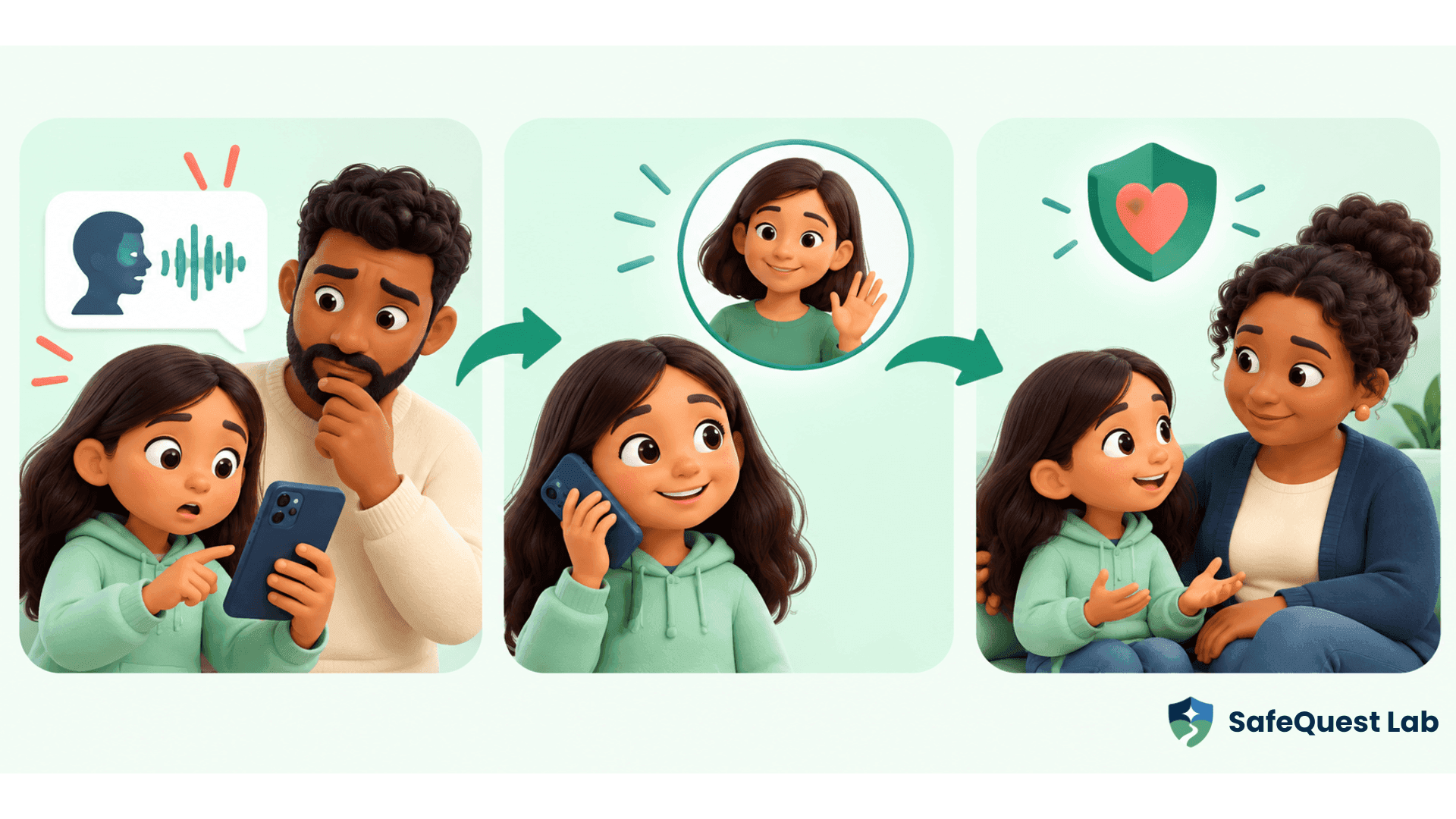
Children should not have to manage messages about money, threats, passwords, personal photos, private family details, or invitations to move to another app by themselves. Make it explicit that telling a grown-up is not “getting someone in trouble.” It is a safe response to an uncertain situation. If the message is from a school, a game, or a family member, an adult can help find the official contact route.
The family takeaway
AI voices and synthetic media are part of everyday digital life. Families do not need perfect detection skills to handle them well. A calm routine—pause, verify through a second route, protect private information, and tell a trusted grown-up—gives children a stronger foundation than fear ever could.
Next step: Practise a simple source-checking routine together before sharing a surprising claim.